|
|
|
|
Kiosk newsbites
by Marc Heberden
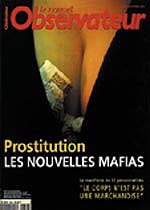
Le Nouvel Observateur Rarely mentioned in tour guides, Paris prostitution has nevertheless
always been a part of la vie parisienne and in the steamier quarters
of the city, tourists mingle with prospecting clientele in hopes
of spotting Irma La Douce. But fatuous as the myth of the happy
Parisian hooker ever was, Le Nouvel Obs relates how the times
are a-changin'. In a near flood of human misery, young women from
Eastern Europe, lured into virtual slavery by unscrupulous advertisements,
are creating an alarming new underworld on Paris’ mean streets.
But given the complex root of the problem, the solution is not
deportation. Prostitution, after all, is the world’s oldest vicious
circle of supply and demand. Le Nouvel Obs tries to untangle the
knot, but acknowledges that sheer numbers (25% of men admit to
having “adventured” at least once), reflect the extremely deep-rooted,
intimate and complex nature of prostitution. And unfortunately
for these Eastern European women, their home country mafias have
discovered the gold lining Paris’ shadowy side.
Lire In a country where prime time TV can include literary talk shows
and the national Spelling Bee, it’s no surprise that Lire is one
of France’s most successful magazines. This month, the book mag
showcases the intense French method actress, Isabelle Huppert,
who describes how her meticulous approach to acting was deeply
influence by author Nathalie Sarraute, an icon of literary individualism
famous for her precise and nearly scientific approach to defining
character.
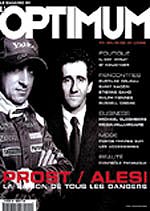
L'Optimum In trying to cobble together a war-torn community, Dr. Bernard
Kouchner, chosen by the UN to be the organization’s special representative
in Kosovo, has found himself at the heart of European darkness.
L’Optimum reports that Kouchner (the most famous of France’s “French
Doctors”— a founding member of Médicins Sans Frontières), in his
struggle to cauterize the post blood-bath mess of the most recent
Balkans crisis, is now faced with a personal stuggle as well:
to continue to believe in his deepest conviction that polical
will can have a positive role in relieving human distress. Kouchner’s
description of daily life in Kosovo is harrowing. But in L'Optimum's
profile of the former French Minister of Health, chosen for this
role because of his unquestioned sense of humanity and highly-tuned
organizational skills for rescue and relief operations, there
is room for hope: “Reconciliation, that’s for later. Here, there
is little love. But I’m a pessimist who acts, [despite it all].
And everyone can see independence is not far away.”
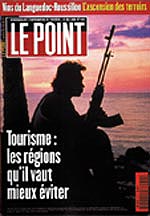
Le Point Over the last decade or so, French tourists have begun discovering
that being French in a foreign country does not mean automatic
immunity from being kidnapped, held for ransom, or worse. In response
to certain French travel companies which develop "high-adventure"
vacations to places like North Korea, Iraq, Yemen, Eastern Turkey
— or the warlord-run islands of the South Pacific — the French
Ministry of Foreign Affairs (a.k.a. the Quai d'Orsay) has finally
boiled over in frustration. French tourists who go for sand-buggy
rides in the Libyan desert, or personal “photo-journalism” jaunts
into Eritrea, are getting chilly receptions once rescued by the
nearest viable embassy. Worst non-obvious tourist ideas: Colombia
and Haiti. Worst obvious places to avoid: Bhutan, Tadjikistan,
Afghanistan, Sri Lanka, Ethiopia, the Balkans... Greatest source
of problems caused by tourists, according to the Quai d'Orsay:
disrespect of native customs and a lack of (monetary) discretion.
|
|