|
Richard Maxwell
by Molly Grogan

Theater @ ground zero
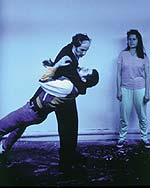
If there were such a thing as “slacker” theater, Richard Maxwell
would probably be counted among its proponents. In the plays of
this 32-year-old American writer and director, actors move sluggishly
across spartan stages, limply delivering their lines while staring
blankly into nowhere. Even when his dispassionate characters break
into song or come to blows with one another, their body language
seldom evokes anything more spectacular than a wet dishrag drying.
Yet what looks like directorial negligence is anything but. As
Maxwell shows this month, in “House” and “Caveman” at Créteil’s
Maison des Arts, his “anti-style” of theater is only too deliberate
and its results are far from boring.
Still, given the look of his plays, it’s hard to understand Maxwell’s
professed disappointment with the terms generally employed — albeit
enthusiastically — in discussions of his shows: deadpan, affectless,
catatonic. He himself has described his work as an exercise in
“coming as close to neutrality” as possible. As he explained on the telephone from New York however,
neutrality is less an end in itself than a means to “democratic”
theater; here, neither the writer’s preoccupations nor the actors’
egos, but the interpretative will of the audience, freed momentarily
from the gestures, tones and clichés of human emotion, comes first.
“It’s a reductive process,” he said, “that’s trying to get past the habits and ticks that are part of [the actor’s] trained vocabulary. It brings
the focus back to the primary element, which is making sure that
the words are heard and understood and that the movements are
clear, and that we’re really trying to get to the essence of something,
of an action, of a task. I’m very curious to see what can happen
when an actor approaches — what is the term? — critical mass or
ground zero.”
“House” and “Caveman” provide an illuminating introduction into
Maxwell’s elemental world. In the first, which won an Obie in
1999, a family’s soporific existence, in which mom vaguely busies
herself with making toast and no one bothers to find out what
dad does, is momentarily disturbed by the arrival of a stranger.
In the second, which will premiere at Créteil, a woman’s search
for her son is interrupted by two men’s struggle to possess her.
The less characters speak, the more they say, and their languid
actions permit a rawer, more unsettling force to come through.
If this sounds unbearably heavy, it isn’t, thanks to Maxwell’s
rhythmic writing and direction, clever spoofing of musical genres
and generous sense of humor.
It should also be said that this deliberately undramatic theater,
which purposely uses amateur actors, is toying with ideas about
the nature of performance. Can we believe what’s happening onstage?
If we cannot, is this still “theater”? For Maxwell, fact and fiction
coexist rather than compete. In his plays, the point is to be
open to both, and to the liberating possibilities that can follow.
“One of the best compliments I got [about “House”],” he explained,
“was ‘My mind kept switching back and forth between real and unreal because of the way things were executed onstage.’ That was really
gratifying to hear. When it gets to that point, things are both
sad and funny at the same time. While there is a story being told,
it’s told in a way that is not inclined to impart some message
to an audience. For me, the highest reality is that there’s a
play happening,” he concluded.
Asked how he came to his style, the soft-spoken Maxwell acknowledged his inability as an actor to “hold up [the] fiction”
of a make-believe world, although it is tempting to trace his
suspiciousness of emotion to a Midwestern upbringing. However
his theater developed, and his shows now play New York’s best
addresses for hip, experimental theater. Meanwhile, France is
proving to be a challenging environment in which to continue his
explorations. When another show, “Showy Lady Slipper,” ran here
last March, Maxwell and company were surprised by the vocal —
verging on rowdy — reactions of their young Créteil audience.
The Festival d’Automne, with its finger on the pulse of innovative
theater, shows characteristically excellent judgement in bringing
Maxwell back.
“House,” Oct 10-14, “Caveman,” Oct 17-21, 8:30pm, (Sat, 7pm &
9pm), Créteil Maison des Arts, pl Salvador-Allende, Créteil, M°
Créteil Préfecture (free return shuttle to Bastille), 55-100F,
tel: 01 45 13 19 19
L’Esclave et le Molosse Greg Germain plays a runaway slave pursued by his owner’s bloodthirsty
dog through the depths of Martinique’s rain forest and through
his own tortured soul, in a one-man show directed, devised and
adapted by Germain from Patrick Chamoiseau’s gracefully poetic
1997 novel “L’Esclave vieil homme et le Molosse.” Oct 5-7, 9 pm, Oct 8, 10, 4pm, Théâtre de l’Épée de Bois, route
du Champ de Manœuvre, 12e, M° Château de Vincennes, then Bus 112
to Cartoucherie, 100F/70F, tel: 01 48 08 39 74
Un barrage contre le Pacifique As the Mother in Marguerite Duras’ novel “Un barrage contre le
Pacifique,” Marie-Christine Barrault is a mad fury of blind determination
and impoverished desperation, trying against reason and ocean
tides to eke a living out of a meager plantation in the Vietnamese
countryside. The story is both the tale of the widow’s feverish
dream and Duras’ childhood in French Indochina. Starring one of
France’s great leading ladies, the show is back by popular demand
after a successful run last spring at the Théâtre International
de Langue Française. To Oct 15, Tue-Sat, 8:45pm, Sat, 5pm, Sun, 3:30pm, Théâtre Antoine,
14 bd de Strasbourg, 10e, M° Strasbourg St-Denis, 80-260F, tel:
01 42 08 46 28
El Pecado que no se puede nombrar (The Unnameable Sin) Argentinian company El Sportivo Teatral
presents a surrealist black comedy about a group of utopian conspirators
working to end injustice by producing a gas that will eliminate
capitalists. In Spanish, with French subtitles (Festival d’Automne).
Oct 14-27, Tue-Sat, 8:30pm, MC93 Bobigny, 1 bd Lénine, Bobigny,
M° Bobigny Pablo Picasso, 65-140F, tel: 01 41 60 72 72
Le Roi Lear This ARRT production marks maverick director Philippe Adrien’s
second major foray into Shakespeare à la française.... (His first
venture was a flamboyantly “updated” Hamlet.) Based on a new translation
by Luc de Goustine (Editions de l'Arche), Adrien’s version of
Lear relies on a multiplicity of unlikely contemporary sources
such as an “interview” with one of the daughters of British press
magnate Robert Maxwell. Oct 3 to Nov 12, Théâtre de la Tempête, route du Champ de Manœuvre,
12e, M° Château de Vincennes, then Bus 112 to Cartoucherie, 120F/80F,
Wed 50F, reservations: 01 43 28 36 36
|
|