Paris-Barcelona is an exciting title! It titillates the museum-goer’s imagination with great expectations based on blockbusters such as Paris-Berlin or Paris-New York, the exhibition which inaugurated the Pompidou Center. Unhappily, this present overview isn’t on the same level, simply because the artistic links described between Paris and Barcelona are a bit sketchy, at best. However, despite the theme’s shaky premise, there are interesting works to discover, and it’s worth going just to see the Picassos and the Impressionists’ paintings once again, in another context.
Films by the Lumière brothers showing both cities at the turn of the century set the stage... The two significant dates around which the expo is built are 1888 — the year of the Universal Exhibition in Barcelona, which coincided with a rich period of expression connected with Catalan modernization — and 1937, the year of the International Exhibition in Paris where the Spanish Pavilion presented Picasso’s “Guernica.”
The exhibit opens with three chronological sections. The first sets out to establish a parallel between French Art Nouveau and Spain’s Modernista in the decorative arts and architecture. The second highlights Rodin’s influence on his Catalan counterparts, while the last contrasts the paintings of Spanish artists living in Montmartre with the works of a selection of impressionist masters.
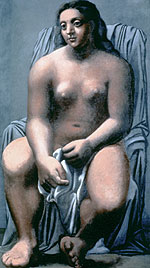
It’s difficult to compare works by minor figures from Spain with the superb compositions of Degas or Monet, who were on their own turf, painting the subjects for which they became famous. Ditto for Rodin’s Catalan disciples. It’s a relief when one finally comes to Pablo Picasso, whose Blue Period was eminently inspired by Degas and Toulouse Lautrec — there the comparison isn’t derisive. Picasso’s pieces stand up to those of the French masters.
The Surrealist group represented by Picabia, Joan Miró and Salvador Dali is also of interest. There’s a reconstruction of Picabia’s infamous 1922 display at the Dalmu gallery, and we are shown how French avant-garde art reached Barcelona. In this area there are six major works by Miró that detail his movements between Paris and the Catalan capital. And a fine, rarely seen series of early Dalis that ends with his first soft, spectral paintings created at the time of the making of the famous Surrealist film “An Andalusian Dog” in 1928.
A startling ensemble of André Masson’s insect paintings is meant to convey the French avant-garde’s penultimate influences, before the fall of Barcelona in 1939. In addition, there are some remarkable photographs by Brassaï, Man Ray and Dora Maar. The circuit finishes with a selection of documents concerning the architectural projects — intended to turn Barcelona into a “radiant city” — that LeCorbusier and his Catalan followers had to abandon, along with a model of the Spanish Pavilion at the 1937 Paris exhibition which featured Picasso’s “Guernica” and Miró’s “Reaper,” both masterpieces on the theme of freedom.
Paris-Barcelona, de Gaudi à Miro To Jan 14, Wed-Mon, 10am to 8pm, Grand Palais, av du Général Eisenhower, 8e, M° Champs-Elysées-Clemenceau, tel. 01 44 13 17 17, 50F/35F