
 |
|
|


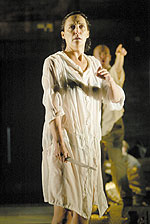 Fiona Shaw in Medea COURTESY OF THÉÂTRE NATIONAL DE CHAILLOT/PHOTO - N. LIBBERT |
Updating Medea
by Molly Grogan  “Horrifically familar as the news” For over two centuries, one name has struck fear in the hearts of audiences like no other: Medea. The mythological figure and heroine of Euripides’ eponymous play, who deals horrible deaths to a king, a princess and, more terrible yet, her own children, has long been interpreted as either a chillingly calculating killer or a murderous madwoman. A new production by the British director Deborah Warner and starring the Irish actress Fiona Shaw, weighs in with a new look at this long demonized and reviled character but insodoing scores a double coup: by casting this larger than life figure as a spurned housewife, Warner renews with the Greek tradition, using theater to reflect back on society some very uncomfortable truths. This latest Warner/Shaw collaboration, which follows earlier powerhouse productions like “Elektra,” “Richard II” and “The Waste Land,” transposes Euripides’ 2 400-year-old tale to that most coveted yet fragile fantasy land of stardom, that is to say, the very center of American culture. Medea and Jason are the kind of Hollywood couple on the rocks whose sordid breakup is recounted in detail in the pages of People magazine, and the Chorus is now composed of five female groupies hot on the scent of scandal. The show, which debuted in Dublin in 2001, has become the hot ticket in New York this winter (causing such a sensation that the Théâtre National de Chaillot, which was due to welcome the play in February, had to reorganize its season to accommodate a 6-week extended run of the play in the US). It's not difficult to see why. While the show’s success lies partly in its contemporary staging — offering a world familiar to transatlantic audiences — the public’s almost voyeuristic fascination with this pop culture Medea seems also to stem from Warner’s laser sharp reading of American life today. This is evident in a myriad of details, from the set (an unfinished McMansion) to the props (toy guns which Medea uses to spray antagonists playfully with imaginary bullets) and the costumes (the classic black cocktail dress worn by Shaw in the earlier European production is exchanged in New York for a typically American look: running shoes and a sloppy cardigan over a little flower-print dress à la Gap). Even the new translation by Kenneth McLeish seems to capture the American idiom, with Shaw substituting “blechs” and “icks” for more eloquent expressions of disgust. Indeed, what is most remarkable about this production is its transposition of the action to a generic landscape of wealth, sex and ambition that, for its anonymity, is no less recognizable to anyone who scans an occasional tabloid or who couldn't help following the frenetic media coverage of the O. J. Simpson trial. This “Medea” reads as precisely the kind of story of murderous passion that inflamed the press and the public alike in 1995 and which evidently remains a riveting subject for the American consciousness. In this Medea's world, children are pawns in deadly games played by grandiose egos, private suffering is served up for public consumption, disputes lead inevitably to war and, in the end, there is no winner and no catharsis, only frustration and emptiness. A review of “Medea” in Newsday claimed that the show’s power comes from Warner’s ability to make Euripides’ story “as horrifically familiar as the news.” Other critics have been amazed to discover a surprisingly human character in Shaw’s interpretation of a woman tortured by sexual jealousy. The genius of Warner's production lies less, however, in its presentation of an “everyday” heroine than in its demonstration of just to what extent the unimaginable and unfathomable have indeed become regular fare in America. “Medea” (in English, French subtitles), Mar 19-30, Tue-Sat 8:30pm, Sun 3pm, Théâtre national de Chaillot, 1 pl du Trocadéro, 16e, M° Trocadéro, 24E/19E/11E, tel: 01 53 65 30 00 |
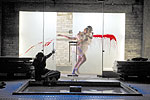 “Medea” COURTESY OF THÉÂTRE NATIONAL DE CHAILLOT/PHOTO - N. LIBBERT |
|

