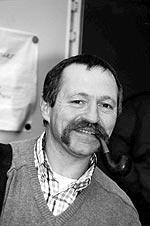
Back in August ’99, a group of angry farmers, including a sheep raiser named José Bové, dismantled a McDonald’s restaurant in Millau, a famously picturesque village in the southwest of France, in order to protest against an American trade retaliation opposing the EC’s ban on hormone-treated meat imports. Since then, Bové has emerged as something of a national hero and his country’s leading critic of agricultural industrialization. Thinking global, he joined protesters on the streets of Seattle in challenging the World Trade Organization. Now, his new book,“The World is Not for Sale,”co-written with Confédération Paysanne spokesman François Dufour, promises to amplify his message among English-speakers.
Did going to Seattle help you communicate with people outside of France?
JB: Yes. Seattle was the beginning for us, internationally. The press didn’t know what we were doing in France or what really happened at the McDonald’s in Millau. Now the issues are better understood...
The resonance of the word “hormone” was obviously to your advantage in getting public support for your cause...
JB: The word “hormone” worries people — so do the initials “GMO,” because they raise questions about the integrity of food. Overnight we realized that globalzation was forcing us to eat food that contained hormones. So on one side of the Atlantic a wholesome product like Roquefort was being surcharged, while on this side we were being forced to eat hormone-treated beef!
Some people were delighted that you took on an American symbol.
JB: Absolutely. But we quickly dealt with that. We didn’t want McDonald’s to be seen as the prime target. It’s merely a symbol of economic imperialism. Besides, we never called for a boycott of McDonald’s... Our political leaders, however, tried to talk up the anti-American element: some by playing the “typically” Gaelic card...
You coined a new word “malbouffe,” which is now part of French vocabulary. Junk food is probably the closest equivalent in English. What do you mean by the word?
JB: The first time I used the word was on August 12, in front of the McDonald’s in Millau. While I was discussing my speech with friends, I initially used the word “shit food,” but quickly changed it to “malbouffe” to avoid giving offense. The word just clicked — perhaps because when you’re dealing with food, quite apart from any health concerns, you’re also dealing with taste and what we feed ourselves with. “Malbouffe” implies eating any old thing prepared in any old way...
For me, the term means both the standardization of food like McDonald’s — the same taste from one end of the world to the other — and the choice of food associated with the use of hormones and GMOs, as well as the residues of pesticides and other things that can endanger health. So there’s a cultural and a health aspect. Junk food also involves industrialized agriculture — that is to say, mass-produced food; not necessarily in the form of products sold by McDonald’s but mass-produced in the sense of industrialized pig rearing, battery chickens, and the like. The concept of “malbouffe” is challenging all agricultural and food-production processes. During the summer of 1999, problems with food went beyond health scares and entered the political arena.
Why are you hostile to GMOs?
JB: We’re opposed to genetic modification in agriculture. It results in plants whose natural developmental “program” has been changed by intervening in its genome. The genome is all the genetic material characteristic of a particular species. Genes are carried on chromosomes... According to some scientists, such genes can be mixed, irrespective of the plant, animal or human species, without causing a problem... genes are paired up. So you can find the genes of a strain of cholera bacteria in alfalfa, a chicken gene in potatoes...
The incentive to research this field is evident. The genetic manipulation of a plant or an animal enables companies, by enforcing industrial patents, to become owners of all the modified plants and animals subsequently produced. By buying up rival seeds and patents, or removing competitors from the market, a firm can become the owner of an entire species. It’s the logic of industry, applied to life. Genetic manipulation is a way of being paid royalties for life itself.
How do you go about explaining these complicated issues to people?
JB: Since I’m a farmer I always begin by talking about the problems involved in that. Then I move on to how these problems are not just that of food, but of the free market, globalization, and the rest. In Seattle, following those explanations, we could then easily show how the WTO was undemocratic. In fact, the most important issue for us is that we have to transform these institutions so they work through democratic discussion — where each country has an equal say and is not drowned out by the voices of multinationals. As individual farmers and consumers, we want, among other things, to have recourse to a specific economic court to appeal WTO decisions.
Have you had any impact on what is being offered to consumers in France?
JB: We had discussions with the people at Carrefour about soy bean importation. We managed to convince them to buy their beans from Brazil, instead of the (“Roundup-ready”) GMO soybeans of the US. And Carrefour is selling them under their own brand as being GMO-free.
Is Europe going to lead the way in worldwide agricultural reform?
JB: More people here have now recognized the need for policy reform. Especially after the mad cow and environmental problems. In Europe, we’ve lost four million farmers in the last ten years. It’s impossible that things can keep on going in the same way. The politicians are now taking this into account. In Germany and England, for example, the names of the ministries of agriculture were changed to the ministries of food, consumers and agriculture.
Interview by Marc Heberden, with questions by Gilles Luneau, originally featured in “The World is Not for Sale” (Verso, New York & London)