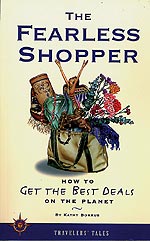
For me shopping has never been about acquiring things,” writes Kathy Borrus, author of “The Fearless Shopper: How to Get the Best Deals on the Planet,” (Traverler’s Tales Books). “It’s about exploring culture and preserving memory — the sights, sounds, smells, tastes, tempo and touch of a place,” writes this globe-trotting shopping expert. In a departure from other such books, Borrus cleverly leads eager readers in a new and more intelligent direction, with instructions on how to buy wisely and most importantly, how to turn each occasion into an artful learning experience.
The writer studied abroad in Amsterdam before landing a job with the Smithsonian Institution Museum shop. Her various assignments led her across more than 40 countries and five continents. Now working as a consultant based in Washington DC, Kathy advises local populations in faraway countries on product development. For Borrus, shopping is an art, a way of becoming more culturally connected to the world. “To shop in a bazaar, a souk or a Third World market is to feel the link with the first traders who bartered and sold along the Tigris and Euphrates, supplying the basics of the day: weapons, food, beads and cloth.”
Throughout the first 12 chapters of her book, Borrus recounts colorful tales of traveling and bargain hunting, accompanied by sidebars about other shoppers’ experiences and observations, and topped off with great practical tips. At the very beginning of the book, there are useful, often overlooked hints on preparing for a trading escapade. “Before you visit a foreign country, learn as much as you can about the customs, traditions, regional specialties and indigenous arts and crafts of that place,” she advises. “You’ll know what specialties to look for when you arrive. Bring along a calculator or create a cheat sheet with the currency rates, especially if you are bargaining in a foreign language.”
When traveling it’s important to dress to fit the circumstances so that people will receive you more amenably. “Your costume is part of the game, giving merchants clues about you and how much you are likely to spend. If you are bargaining at an open-air market, you don’t want to look ritzy, so it's best to leave your good jewelry and expensive outfits at home.”
On the other hand, “If you are shopping in a fancy boutique, you’ll be treated better if you dress up.” The chapter on “Safe Shopping” dispenses tips on protecting yourself from pickpockets, schemers and purse snatchers. “Once in a bookstore in New York City,” she tells, “three women bumped me and lifted my wallet. Those three lucky women got to split four dollars. They didn’t know I had $150 in a white envelope right next to the wallet.” In addition to hiding cash in different pockets, bags or money belts, she also advises attentively watching merchants wrap your merchandise to avoid “bait and switch” scams. “You may pay for one thing and get something of lesser value. Check your package before leaving the shop or market.”
Shopping is more than just buying things. It’s an adventure in itself. “Every time I wear my cowhide and fabric boots, I’m reminded of Marrakech and the leather merchant who patiently waited for me to try every boot on his mat for just the right fit. A conversation piece, they are warm, comfortable and durable — all for 12 dollars. To paraphrase Gertrude Stein, a find is a find is a find. It doesn’t matter where. Whether you comb antique shows or haunt flea markets, the fun is in the search and the accidental find.” Here, there are valuable tips on antiquing like, “Pretend you’re a seasoned buyer. Ask the price first. Neophytes tend to ask about the item first.” And, “Unless you can tell the difference between a fake and something that is authentic, don’t buy. For the collectibles that really interest you, consider attending classes, doing research and studying price guides.”
Shopping in foreign markets brings its own set of adventures and challenges. “Always bargain and do it in a spirit of fun and friendliness. Learn as many phrases and numbers in the native language of the marketplace. Learn to say ‘too much’ in any language. This will help you bargain with confidence. The small tokens you brought from home, such as pens, key chains, caps or T-shirts can be used to barter for an item that interests you, especially if the merchant has expressed an interest in them. Ask permission to take photos of a stall or shopkeeper. If your purchase is a gift you can use the photograph as a gift card.”
An entire chapter is devoted to “Bargaining” at both beginner and advanced level. There are unspoken rules to this art and the golden rule seems to be “Once you and a vendor have agreed on a price, it’s usually impolite to back out. You’ve taken the merchant’s time and reneging now is considered rude. Wait to bargain until you are ready to buy. If you feel pressured, you can always step outside the shop to think the deal over.” Haggling should be undertaken as a healthy sport without being pushy or rude. As you move into advanced bargaining learn to be an actor. “If something is too expensive, act horrified,” Borrus suggests.
“And, whether you actually buy anything or not, shopping is about having fun,” concludes the author.