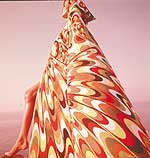
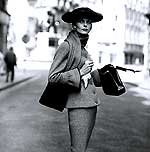
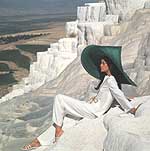
Just in time for this year's “Le Mois de la Photo”... The Musée de la Mode de la Ville de Paris has decided to “show off” its latest donation — fashion photographs by the late, great Henry Clarke. Comprised of 20 000 negatives and slides, 5 000 prints and contact sheets, the legendary output of this American-born photographer is on view until next March. Two decades of Clarke's work chronicle the veritable Renaissance of French couture from the postwar “New Look” to the mod squad of the ’60s.
In putting together this exhibition, existing pictures from the collection — either prints or published magazine pages — were given top priority. French Vogue’s archives contributed various series originally intended for publication. For instance, the winter 1951 haute couture collections. What the museum didn’t possess but considered vital to the expo was compiled from existing negatives. As it turned out, this made it possible to use the totality of each image — before it was cropped. It was also interesting to unveil alternative versions of previously published images. What is particularly remarkable about this exhibit is that its curators have been to the trouble of locating a good many garments and accessories actually featured in Clarke's pix and Vogue magazine's editorials. Altogether, this adds an appealing “3D touch” to what would normally be, a two-dimensional display.
Henry Clarke first discovered his vocation after coming across dossiers by photo-icons like Hiro, Penn and Beaton, while working as a prop man for American Vogue in New York. However, it wasn’t until Clarke arrived in Paris in 1949, that he picked up a camera, beginning his own career in this medium. A couple of years later he “signed” with Conde Nast and, for two decades, went on to photograph the world's most famous models and celebrities, all clad in the spectacular creations of France's haute couture elite — Dior, Balenciaga, Chanel, Jacques Fath and many others. As a whole, his œuvre constitutes a full-fledged panorama of French high fashion during its glory days, a bygone era when models were real women — not dressed up 15-year-olds — and clothes were drop-dead glamorous.
The first room consists of a mix of published and unpublished material produced between 1948 and 1968, along with 15 garments. Via photography, each of these outfits takes on a distinct allure — almost “foreign” to its actual appearance, revealing the photographer’s "art" in the process. In the eyes of the general public who leafed through Vogue’s glossy pages in those days, Henry Clarke depicted his models as if they were women of the world, haute couture clients, ladies who lunch... This was a milieu everyone wanted to be part of, or at least emulate. And yes, the models were très “posed,” but like the ladies who belonged to this hush-hush world of high end luxury, each of their overtly reserved gestures was planned and poised, then preserved to produce an overall look of... elegance.
The last section documents fashion photography as it started to be taken out of the studio, and into faraway places... with breathtaking landscapes or historical monuments in the background. In 1962, Clarke worked in tandem with Diana Vreeland who commissioned him to produce a 20-page spread for American Vogue's "resort issue." The models were statuesque. Their sculpted hair, artistically designed makeup and colorful garments turned them into living “works of art” that fit in with their exotic backdrops perfectly. These were the selfsame magazine pages that initially inspired my own way of dressing, my way of looking at style and everything around me. In these days of helter-skelter "fash trash," destroyed jeans, rumpled T-shirts, soiled sneakers and plastic hair clips... This tribute provides a much needed escape back to an epoch when the fashion world made so much more sense.
To Mar 2 2003, Tue-Sun 10am to 6pm, Musée de la Mode de la Ville de Paris (Palais Galliera), 10 av Pierre 1er de Serbie, 16.e , M°Iéna, tel: 01.56.52.86.00.,7E. On Wednesday, December 18, 5-7:30,pm you can take part in a round table discussion with the museum's curators, along with Suzanne Train (director of Conde Nast), Frank Perrin (director of the Crash review), and Christian Caujolle (director of the VU agency and gallery).