 |
|
|


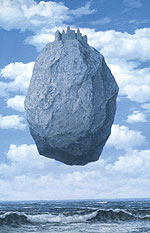 Le Château des Pyrénées, 1959 COURTESY OF JEU DE PAUME/© ADAGP, PARIS 2003 |
Magritte
Sandra Kwock-Silve  ...artist as clairvoyant In one painting a castle perched upon a boulder floats among the clouds high over an idyllic landscape. In another a large green apple hovers obscuring the face of a man in a bowler hat. Welcome to the strange and haunting world of René Magritte. These works are just a few of over 150 paintings, collages, sculptures and photographs on view in the Jeu de Paume’s superb Magritte retrospective — considered to be the most important show to honor the great Belgian Surrealist over the past two decades. All in all, this is a visual treat... The walls of one room are painted like Magritte’s blue, cloud-covered sky, with exhibits seeming to float in a radiant aura that enhances the artist’s subtle dark-hued palette. Unlike most tributes of this kind, this isn’t a conventionial historical display with an introduction to each section, but rather as a celebration of the impact Magritte’s creative output on contemporary art, film and publicity during the second half of the last millennium. Although each group of paintings is shown in date order starting with a series produced in 1925, the usual biographical timeline is missing. René Magritte is fêted as the creator of unforgettable images that have shaped the public’s visual imagination. Looking into Magritte’s strict and rather bourgeois life, it is tempting to say that he doesn’t quite live up to his extraordinary art. He lacked the flamboyant personality of André Breton — and actually maintained a rather distant relationship with the French Surrealists, after an unfortunate incident with the latter during the winter of 1929. But perhaps that’s the key to our continuing fascination for his imagery. Indeed, his self-portrait as the “ordinary fellow” in the dark suit and bowler hat was a projection of himself as Every Man. However “ordinary” Mr Magritte, may have appeared, his paintings were the exact opposite. Troubling and provocative, the artist’s powerful images are better known today then they ever were in his lifetime. Daniel Abadie, the museum director and curator of this homage, explains that he has set out to “show how Magritte’s vision has influenced contemporary creation since the ’60s. This is why we chose to feature the ‘writing’ series that announced conceptual art and his representation of objects that anticipated pop art.” René Magritte’s conceptual content places his work in a category of its own. In the painting “Clairvoyance,” he is seated at his easel painting a bird on a large canvas, while studying an egg that is poised in the foreground before him. This self-portrait of the artist as a clairvoyant able to perceive the future eerily describes Magritte’s own exceptional, intuitive vision concerning the future of art. The Jeu de Paume’s overview positions Magritte way beyond the confines of surrealist preoccupations. Magritte — to June 9, Tue-Sun, noon to 7pm, Jeu de Paume, 1 pl de la Concorde, 8e, M° Concorde, tel: 01 47 03 12 52, 8 € |
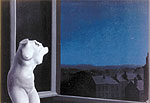 La Belle de nuit, 1932 COURTESY OF JEU DE PAUME/© ADAGP, PARIS 2003 |
|
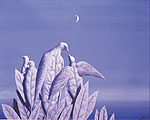 Les Grâces naturelles, 1948 COURTESY OF JEU DE PAUME/© ADAGP, PARIS 2003 |
|

