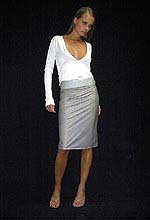
Elsa Esturgie ensemble
© W.A Dudley |
|
Fashion start-ups
by Carol Mongo

At the cutting-edge with new fabrics
The 21st century has finally arrived in France via its fresh talent. To get a sense of how style is shaping up at the start of the millennium, one must turn away from the splashy shows of some of the more established couturiers still seeking refuge in the 1960s, ’70s or early ’80s, and venture off the beaten track to young designer fairs like Workshop, Carole de Bona and Tranoi.
All the experts agree on one point... There are no ground-breaking silhouettes to be created. Innovation in textiles is becoming “the base” for a generation of new age designers. We saw this direction emerging from Japan years ago with trailblazers such as Issey Miyake who, with his Design Works laboratory was light-years ahead of everyone, beginning experiments that gave birth to his striking “Pleats Please” line of densely pleated tops, skirts and dresses.
Over the past six seasons, Hiromichi Nakano, already a household name in Japan, has been drawing crowds to his défilés in Paris with garments cut from his own inventive fabrics. Last season we were treated to linen tops and skirts splattered with bright primary colors that, from a distance looked like strokes of paint. Viewed up close, those “brushstrokes” were in fact felt applications cleverly woven through. This season Nakano resorted to laser cutting to create a sort of third millennium lace out of thin silk used all over, or just in spots.
This trend favoring textile-based apparel is finally infiltrating the design milieu in Europe. Many leading fashion schools are incorporating textiles into their curriculum. Artisanal methods are used to produce creative styles, enabling designers to distinguish themselves from corporately driven fashion. Since the innovation is often subtle, the only way to appreciate the garment is to see and touch it up close. So, these are not looks likely to be found on a runway.
“I want to make clothes that entrench you in my philosophy, a philosophy based on nature and mankind,” proclaims Eun Kyung Jo, who feels that the mass-produced garments in the marketplace lack the human touch. The designer behind the EKJO label insists, “I want to make clothes that are comfortable yet elegant.” The first thing that drew my eye to her stand was a jute dress featuring a graphic floral and fauna print. “I had to pass the color a couple of times, but finally it took,” she sheepishly admits. Not only had she made the dress, but it was handprinted as well.
A few garments down, a delicate little blouse caught my eye. It was made from handcrafted paper with dried flowers pressed in and treated to help keep its form. Eun, a native of South Korea, made France her home in 1997 after completing her studies at the very traditional Chambre Syndicale de Couture school and Studio Bercot, an establishment noted for its avant-garde approach to fashion. She worked for the OSI design firm in Korea and later for Kim Bernadin, Antonio Azzuolo and Eric Bergere before launching her own label. This is her first collection, yet it seems to have been put together by a seasoned veteran. She brings both her Korean culture and French savoir-faire to her summer collection in the form of surface treated natural materials and simple, easy-to-wear shapes.
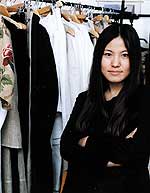
“First I start with textile research,” declares Elsa Esturgie, “then I think about the silhouette.” The clothes behind her resemble shadowy silhouettes in a forest at dusk. A-line dresses, with shawls and Empire waist sheaths, have streaks of shiny fibers swirling rhythmically up from the hem. “It’s viscose,” she answers. “I love exploring different effects with materials,” she adds. Elsa’s training was at the Ecole des Arts Deco. Her collection is striking: sober dresses, T-shirts and skirts in a neutral palette of slate grey, black and creamy white.
This is German-born Nicole Edeler’s 12th season for at Workshop who moved to France 10 years ago. “Felt is what I like so it is present in all of my collections including summer.” Her tiny display includes sheer pastel organza dresses in a sculpted A-line shape, simple shirts and shawls... all of which incorporate vibrant felted circles of varying sizes dispersed over the front and back. On the wearer, the result resembles a living, breathing abstract painting in motion. “I’ve always used felt,” she explains while showing me patchwork felt garments from her winter collection. “The challenge for me this season was how to continue using it for another summer.” She turns up the underside of the dress. “It’s felted on both sides of the fabric and the way I’ve used it makes the felt appear light.”
Nicole studied at the Beaux-Arts school in Berlin and collaborated with theater playwright, Robert Wilson before striking out on her own. This experience with Wilson helped to add a new dimension to her work. “Color is very important,” she says as she caresses a hand-knitted top with a small cap over the shoulders. With their bright color palettes, you can visualize these skimpy tops and sweaters on a dancer, just as easily as the girl next door.
Very much a break in the look and philosophy from the other stands, but undeniably modern is that of another fashion start-up, “Djoll.” Here, the basis of the collection rests on clean lines with tiny details to distinguish it. For instance, leather piping or inserts to hide seams and rough edges which, at the same time, add a graphic touch to an otherwise minimalist look.
Though he is not creating his own materials, Jean Olivier Letard, uses new age fabrics: authentic-looking faux suedes, ultralight, wrinkle- and water-resistant Super 110, in the pure, body-skimming shapes of his dresses, tops and trousers. Letard and partner Dimitri Rodziminaki, who manages the business end of Djoll, met in 1998 and a year later formed their company. Drenched in neutral tones with cobalt blue as an accent, all of the pieces in this “modular” collection were designed to work together. Pieces can be added or subtracted to take the wearer from one situation to another within the same day with the greatest of ease... a smart idea, and an uncluttered look most certainly headed for a brand-new century of style.
|
|