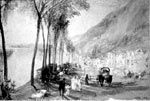
“Le Maroc de Matisse” at the Institut du Monde Arabe is one of the most luminous and uplifting shows of the season.
During the winter of 1912 — and again at the end of the following
year in 1913 — Matisse fled cold, gray Paris to spend nearly nine
months in Morocco.These sojourns were to leave a lasting impact,
taming the wild fauve and adding the colors and motifs of the
Orient to his work.
Featuring over 50 paintings and drawings that Henri Matisse produced during the two long
periods he spent in Tangiers, this thematic overview opens with
photographs and documents evoking his interest in Islamic art.
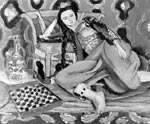
A second portion highlights the exotic, veiled odalisque, as a
major and recurrent theme. And, a display of the artist’s colorful
large-scale paper cut-outs concludes this exhilarating celebration
of the decorative patterns that Matisse discovered in ceramic
murals and Oriental carpets.
On loan from Moscow’s Pouchkine Museum, the famous Moroccan Triptych painted for the Russian collector Morosov is one of the high
points of the exhibition. Although completed just a few months
after a period of tremendous self-doubt, this key composition
illustrates the synthesis between eastern influences and western
art that was emerging in Matisse’s research. Uncertain about this
change of approach, he wrote to Gertrude Stein on March 16, 1912:
“Painting is something quite difficult for me... there is always a fight! Is this natural? Yes, but why must it
be so hard?”
Inspite of his painterly concerns and the rain that plagued the
first weeks of his stay, the luxuriant vegetation fascinated Matisse
and the colors of Tangiers gradually filled his palette. He enjoyed
and freely acknowledged the romantic associations of the Orientalist
School; saying that Morocco was “just as Delacroix painted it.”
Contrary to his habit on other trips, he did not feel the need
to travel and explore the country. He was inspired just looking
out of the window, or wandering among the brilliant-hued palms
and flowers in the hotel garden..
Matisse’s Moroccan experience marked a new direction: “What I dream of is an art of balance, of purity and serenity devoid of troubling or depressing subject
matter, an art which might be for every mental worker, be he business
man or writer... like an appeasing influence, like a mental soother,
something like a good armchair in which to rest from physical
fatigue.”
The exhibition closes with the chromatic radiance and decorative, non-figurative vegetal motifs sublimated in the
stained-glass windows that the artist created for the Chapelle
du Rosaire in Vence in 1951. These were clearly inspired by the
Islamic works he had admired in Tangiers so many years earlier.
Matisse’s determination to express the spiritual in art led him
to simplify color, light and form. On completing the Vence project,
he noted “After this refining process, I leave my sandals at the
door, as in a mosque.” A beautiful, inspiring show for the holiday
season.
“Le Maroc de Matisse,” daily from 10 am to 6pm, closed Mon, to
Jan 30, Institut du Monde Arabe, 1, rue des Fossés-St.-Bernard,
5e, tel: 01.40.51.38.38, Mº Jussieu, 50F/45F.
Turner’s Seine
On show at the Pavillon des Arts, “Turner et la Seine” is another visual delight The exhibition features sketches, watercolors
and engravings produced during Turner’s various journeys to France.
During each trip, the daily life and landscapes he observed along
the Seine were a great source of inspiration. Turner was able
to travel to the European continent for the first time in 1802 after the end of hostilities between England and France. He was
27 at the time, and already a member of the Royal Academy. Although
actually bound for the Swiss Alpes, he made a stop in Paris to
visit the Louvre.
On a second stay in 1819, he spent alot of time sketching along
the Left Bank from Pont-Royal to Saint-Cloud. However, it was in 1821 that he truly discovered the Seine.
Arriving by boat; he followed the river all the way from Le Havre
to Paris.
Four successive visits to France allowed him to explore the Seine in each direction
in an almost scientific fashion, sometimes leaving the riverbanks
to sketch surrounding villages and landscapes. Climbing hills, he painted vast panoramic landscapes under the cloudy skies
of Normandy.
Turner’s works also record the transition of these lovely rural landscapes toward the urban sprawl that we are familiar with today. He was
clearly impressed by the large steamboats he saw, and included
them in his paintings along with the mills and factories that
he encountered. These subjects add an unexpected and arresting
modern edge to an otherwise soft and painterly body of work.
At the beginning of 1827 Turner created a series of engravings on the theme of the Seine
named “The Keepsake.” The great success of this album inspired
him to prepare a sucession of travel books titled “Turner’s Annual Tour.” It was for the numerous exhibitions organized around these publications,
that Turner prepared many of the beautiful watercolors and drawings
on view in the exhibition. A rare treat for the eyes.
“Turner et la Seine,” daily 11:30am to 6:30pm, closed Mon, to
Jan 30, Pavillon des Arts, Les Halles-Terrasse Lautréamont, 1er,
tel: 01.42.33.82.50, Mº Les Halles, 35F/15F.