While her dogged defenders and equally adamant detractors dispute
her place in literary history, Gertrude Stein continues to prove a force to reckon with, especially in the
theater. Directors Robert Wilson and Richard Foreman are among those who profess inspiration by Steinian concepts
such as the continuous present, syncopation and the nature of
language being sound and rhythm.
But if the very nature of Stein’s scenographically-challenged
theater, which does away with stage directions and identifiable
characters, has proved a hindrance to numerous productions of
her work, in “House/Lights” by New York’s The Wooster Group — invited to Paris this month
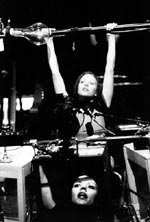
by the Festival d’Automne — they are assets indeed. Director Elizabeth LeCompte has taken Stein’s unconventionality and run with it, cleverly
layering a 1960s softcore cult movie by Joseph Mawra over the
repetitive language and fractured characters of Stein’s opera
libretto “Dr. Faustus Lights the Lights,” to explore questions
of chronology, perspective and identity that are important to
understanding not only Stein but our late-century world.
Stein wrote her version of the Faust legend in 1938, little more
than a decade before the development of artificial intelligence, but already her doctor’s invention of electric light, rendering
the sun obsolete and thereby destroying the natural order of time,
had put him in league with the devil. While the author worries
about the consequences of technology on human existence, the Wooster Group, founded in the 1970s by LeCompte, Kate Valk (Faustus), Willem Dafoe, Spaulding Grey
and others interested in deconstructing classic texts using the
tools of our multimedia age, employs technology to clarify Stein’s
enigmatic theories.
The idea of the continuous present comes to life through the intertwining
stories of Faustus and “Olga’s House of Shame.” Scenes from the B-movie (an unintentionally camp trash tale of
jewelry smuggling and bondage) are imitated, not quite simultaneously,
by the same actors in their Faustus roles. Worlds collide, subside,
fall into sync; everything is only what happened already and the
moment lives on and on.
Discussion of Stein’s theories nevertheless comes a distant second
to the high-tech wizardry, wry humor and postmodern vision that
make watching “House/Lights” so much fun. A couple of examples:
video enables Valk (who plays Faust as a 1930s movie siren, in
an excessively padded dress and a Betty Boop voice) to also play
the two-women-in-one Marguerite Ida/Helena Annabel character,
while TV and film clips and nods to every movie genre spoof the
myths of our image-oriented culture.
According to TWG, “House Lights” is “theater as an all-too human dance with technology — not a warning against it — where the technology, like [Faustus’]
dog, is man’s best friend.” Luckily for Stein, the modern world
she feared would oppress us is keeping her work very much alive.
“House/Lights,” Dec 8-18, Wed-Sat, 9pm, Sun, 5pm, Théâtre de la
Bastille, 76, rue de la Roquette, 11e, Mº Bastille, 120F/80F,
tel: 01.43.57.42.14.
Leveaux directs “Trahisons”
With a love triangle at its center and frequent jumps in time,
Harold Pinter’s “Trahisons” (“Betrayal”) is on the surface a labyrinth of infidelities. English
director David Leveaux told me, however, that the play is rather “a brilliantly engineered
map of the way memory works.” A subtly pared down set and tableaux-like
scenes help to convey the way the mind focuses on and enhances
objects and events over time: a window in a hotel room becomes
big enough to let a church bell through, the bed in the lovers’
apartment seems over large in comparison to the other furnishings.
That cleanness is complemented by a clarity of gestures, words and silences that bring the ebb and flow of the relationship
between Emma, Jerry and Mike to a climax, or the “absolute statement
that love exists,” according to Leveaux, even while working back
in time to its beginning. Reducing down to the point of greatest
energy is the essence of this director’s style, seen previously
in the award-winning “Electra” (1997-98). “Trahisons” lends itself to this approach; as Leveaux explains,
“It’s a play in the end about a kind of solitariness that comes
as a consequence of betrayal, betrayal of each other and betrayal
of ourselves... It’s a play about articulate people with utterly
inarticulate hearts.” And, he admits, “the combination is arresting to me.”
“Trahisons,” Tue-Sat, 9pm, Sat, 6pm, Sun, 3:30pm, Théâtre de l'Atelier,
1, pl Charles Dullin, 18e, Mº Abbesses/Anvers/Pigalle, 50-220F,
tel: 01.46.06.49.24.
Theater selections
In “La Chambre bleue,” Michel Blanc’s adaptation of David Hare’s “The Blue Room,” itself
based on Arthur Schnitzler’s 1912 play “La Ronde,” Daniel Auteuil
and Marianne Denicourt excellently fill the roles played to critical
acclaim and popular titillation last season in London and New
York by Iain Glenn and Nicole Kidman, with more humor and less
sexually-explicit action. Though the text is the same, the result
just seems, well, more French: a less apprehensive, more sophisticated
look at sexual desire and disappointment.
Tue-Sat, 8:45pm, Sat, 5pm, Sun, 3:30pm, Théâtre Antoine, 14, bd
de Strasbourg, 10e, Mº Strasbourg St-Denis, 80-280F, tel: 01.42.08.77.71/76.58.
Peter Brook, as part of his current season of South African theater, directs
the story of a different kind of ménage à trois: a man, his wife
and a suit, in “Le Costume,” set in the once vibrant township
of artists and musicians known as Sophiatown. In addition, the
actor Bakary Sangaré reads in French James Baldwin’s essay “The
Fire Next Time” about the author’s experiences as a young African
American man coming to terms with race relations in the US in
the 1930s and ’40s.
“Le Costume,” Dec 7 to Jan. 29, Tue-Sat, 8:30pm, Sat, 4pm; “La
prochaine fois le feu,” Dec 13 to Jan 28, Mon, 8:30pm, Thu-Fri,
11pm, 100F/50F, Théâtre des Bouffes du Nord, 37 bis, bd de la
Chapelle, 10e, Mº La Chapelle, 80-140F, tel: 01.46.07.34.50.
Denis Lavant and Vincent Schmitt are an explosive duo as Prince Myshkin and Rogozhin in “L’Idiot, dernière nuit,” an adaptation by Zéno Bianu of the ultimate sc
“The Idiot.” Until Dec 11, Wed-Sat, 8pm, Sun, 3pm, Théâtre de
l'Odéon-La Cabane, 36/38, Quai de la Loire, 19e, 50-120F, MºJaurès/Laumière,
tel: 01.44.41.36.36.
Irina Brook directs “Danser à Lughnasa,” Brian Friel’s hit play from 1990, in French.
Until Dec 19, Tue-Sat, 8:30pm, Sun, 3:30pm, MC93 Bobigny, 1, bd
Lénine, 93000 Bobigny, Mº Bobigny-Pablo Picasso, 80-140F, tel:
01.41.60.72.72.