Probably the most accessible and entertaining ballet ever created,
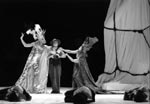
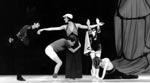
“Nutcracker,” is now a holiday classic. This month Mauric Béjart is performing his very own personal vision of the ballet at the
recently re-opened Châtelet-Théâtre Musical de Paris.
Like “Sleeping Beauty” and “Cinderella,” the “Nutcracker,” which is based on one of the “Tales of Hoffman,” has inspired dozens of versions since it was originally created
in 1892 at Saint Petersburg’s Marinsky Theater, by French choreographer
Marius Petipa, with a hit score by none other than Piotr Tchaikovsky.
Now it’s Maurice Béjart’s turn to have a go at the legendary yuletide fairy-tale, about a little girl, Clara, who dreams on Christmas eve that
her nutcracker doll comes to life as a prince charming whisking
her off, on an enchanted journey where she encounters an army
of mice and an array of other exotic Wizard of Oz-like beings.
Béjart’s “Nutcracker” promises to be far from faithful to the
romantic all-audiences versions of yesteryear. Unlike other choreographers
of his generation such as Roland Petit, Béjart could never be
accused of being a purist. He’s never been one to be attracted
to the idea of remakes or revivals.
In his more than 50-year-long career, he’s been a bold experimenter with content and form, and his grandiose visionary super-productions
with casts of thousands like last year’s “Mutationx” (whose theme was a radiant judgment day after the apocalypse)
at the Palais des Sports, or Beethoven’s Ninth Symphony and the
spectacular “Ode to Joy” movement often call to mind the Hollywood heyday of Cecil B.
De Mille and D.W. Griffith. Unsurprisingly, Béjart considers himself
a messenger, a modern-day cultural prophet using his art to try
to make the world a better place.
In his “Nutcracker,” he’s kept the original Tchaikovsky composition
intact, but his hero is a poor little boy this time. Béjart’s semi-autobiographical tale is inspired by his own motherless childhood and Christmas
memories.
Béjart recently described his “Nutcracker” this way: “On Christmas
eve,” a child is sitting alone next to an aging Christmas tree
hung with a few fraying strands of garland. His mother is dead,
but suddenly in a dream or as if by magic, she appears and places
a big box under the tree, from which friends emerge to keep him
company. A night of enchantment follows. Reality and fantasy are indistinguishable and after seeing/imagining
a moving pas de deux, the boy has a revelation that he must become
a dancer.”
Three characters merge into one: Drosselmeyer (the original “Nutcracker”
magician), Faust’s Mephisto and Marseilles-born Petipa (a magician
of movement), all three of whom Béjart clearly idientifies. The
mother figure dominates throughout (incidentally, all the costumes
were designed in keeping with real family photographs of Béjart’s
mother) and the atmosphere is nostalgic, colorful and optimistic, the indelible Béjart trademark.
Béjart’s Nutcracker expresses in movement the spirit of what having
a “merry Christmas” means, regardless of age or creed. A wonderful
holiday gift indeed.
“Casse-Noisette” (The Nutcracker) Maurice Béjart/Béjart Ballet
Lausanne, Music: P.I. Tchaikovsky performed by the Orchestre Colonne,
Dec 10 & 11, 14-18, 21-25, 28-31 at 8pm; Dec 12, 19, 26 at 5pm;
Dec 14 at 2:30pm. Châtelet-Théâtre Musical de Paris, 1, pl du
Châtelet, 1er, M° Châtelet., tel: 01.40.28.28.40, 55-345F.