|
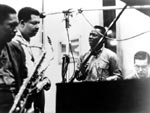
John Coltrane, Cannonball Adderley, Miles Davis, Bill Evans
©Don Hunstein |
|
Miles & Trane
by Tim Baker

Back to the Future
“There’s an African proverb that a man becomes more powerful after
death,” singer Cassandra Wilson says. She’s in town to launch her tribute album to Miles Davis,
“Traveling Miles,” and she’s talking about the trumpeter and his long-time collaborator,
saxophonist John Coltrane. “Miles is mighty powerful right now. Maybe he’s orchestrating all of this from behind the scenes!
But it is strange. All of a sudden there’s this thing about Miles
and this thing about Trane. It’s definitely in the air. There
are a lot of musicians who have only now started trying to decipher
John Coltrane. It’s unfortunate but it takes someone’s dying for
you to begin to miss them.”
One of the classic Miles numbers on Wilson’s CD is “One Day My Prince Will Come,” from “Snow White.” Wasn’t that a particularly odd choice for
Miles to have made? Wilson immediately points out that Coltrane
had been drawn to an equally unlikely number, “My Favorite Things.”
“You have to remember that the songs from those musicals were
very strong, structurally. You can’t belittle the songs. I think
you have to use that sentimental association, which is what Miles
and Trane did. They could have been ironic, but they went with
emotion instead.” In fact, Coltrane’s interpretation of “My Favorite
Things” is remarkable for its absolute sincerity. Technically,
it’s about going far beyond yourself and still achieving recovery.
Thematically it’s about yearning, and the redemption that can be forged out of acceptance.
But while their ability to transform and reinterpret their material
inspired countless musicians, their influence could also be dangerous.
The gravitational pull of their sound was so compelling that disciples
were often crushed by its force. Star saxophonist Charles Lloyd has often been accused of being too close to Trane’s orbit. We
spoke about it earlier this year. “Trane was very definitely important
to me. One of the shoulders I stood on. I knew him. And I admired
him so much. He was very encouraging and he had that spiritual
direction which was touching to me, yet he brought the whole tradition along. He was a very quiet,
deep soul. Sometimes people compare me to him and despair of something...
I think there’s something of my sound from him as there’s something
of his sound from Dexter Gordon, but I think my sound is different. But I love him very much.”
The Davis-Coltrane partnership worked so well because they were complementary opposites, Miles
playing Picasso to Trane’s Matisse, yang to his yin. It was Davis
who brought them together when he assembled his first permanent
band in 1955. Although he had overcome his heroin problem, Miles
had been written off as a washed-up junkie. His small group of
remaining fans were disappointed to learn that Miles had selected
Trane as his sax player and not Sonny Rollins, as had been expected.
But the chemistry was perfect. During the six years that Trane was in Miles’ group, they created many classics including
“’Round About Midnight” and their album, “Kind of Blue,” remains
a milestone in contemporary music. Now the entire body of their
work has been released in a box-set, “The Complete Columbia Recordings
of Miles Davis and John Coltrane.” Spanning the period 1955-1961, the set includes 54 tracks, 18 of which are previously unreleased.
Warner Bros. have taken this opportunity to re-release all the
Prestige sessions of Miles and Trane’s collective work in several
boxed sets.
Having achieved extraordinary success together, both men reacted
to it in the same way: by refusing stylistic stereotypes and moving
down separate paths. Their fans felt betrayed, reacting with bewilderment
to Coltrane’s experimentation; denouncing Miles for “selling out.”
A generation later, the integrity and importance of their later
work is undeniable. Cassandra Wilson is right, only it is not
death that has made them more powerful. It’s time.
|
|