|
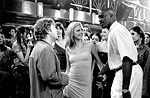
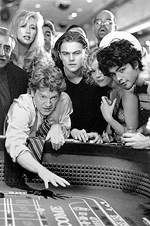
A pale but perspicacious Woody Allen brought his annual cold to his annual press conference just before Christmas. Allen shared the podium with Kenneth Branagh, who stars in "Celebrity" (out Jan 27), playing a Manhattan-dwelling magazine writer named Lee Simon. An awful lot of people think Branagh is really playing Woody Allen. Even though Allen's is a body language only one man need ever speak, Branagh does indeed "do" Allen, replicating both his stammery diction and his nervous tics. Branagh says, "It honestly didn't occur to me to try to play Woody. The cinematic landscape that Woody presents is so distinct that anyone who plays 'the guy' seems to come across as Woody." Allen says he chose Branagh so as to make an unsympathetic character more pleasant to watch. "What I wanted was someone who could capture the NYC nervous anxious tension that I usually write about. I also needed someone who could get all the laughs I put into the character, who had desperate desires, but could also arouse sympathy." But Lee remains a spineless worm who probably thinks moral fiber is something he can acquire by including more oat bran in his diet. He's a weasel who, when offered a brass ring (a fling with a model, a settled home life with a smart, supportive mate) persists in trading it in for one made of plastic or papier-mâché. As Lee makes one selfish, compulsive bad choice after another, we want to slap him and tell him to get a grip. Casting Branagh as the leading man may have been an error on the order of hiring Joe Pesci to play James Bond, though the rest of the cast nearly compensates for this irksome flaw. Melanie Griffth is sterling as a leading lady who makes leading remarks. Charlize Theron (whose rather odd name, speaking of celebrity, is beginning to sound as "Yeah, sure, why not?" as the once-jarring Oprah Winfrey, Uma Thurman, Gwyneth Paltrow and Quentin Tarantino) is pitch perfect as a runway model with unusually receptive skin. Leonardo DiCaprio is excellent as a spoiled young thesp with definite ideas about the proper protocol for dissipating one's youthful energy. Judy Davis's performance is annoyingly erratic, but her character's transformation from mopey intellectual to bubbly purveyor of trivia and non-events is the best mini-editorial in the whole script. Can just anyone attain happiness via vapidity, "Celebrity" asks, or must one be to the mannerism born? In his new book "Life: The Movie," Neal Gabler posits that "entertainment is the primary standard of value for virtually everything in modern society. ... [T]o be a celebrity is widely regarded as the most exalted state of human existence." Could've fooled me I thought watching a really good movie was the most exalted state of human existence. Allen chalks up the inescapable emergence of celebrity as a goal in itself what he calls "this trend toward celebrity run amuck" to the enormous influence of television. "Soon there will be no audience left, there will only be celebrities," he quips. "Every lawyer, doctor, chef and clergyman has his own show. The country is all about show business. We have a very good president who is being persecuted for an affair with a consenting adult an affair that his wife is perfectly willing to accept. The extreme right has made us an international laughingstock." For those of us who put stock in laughter, Allen has been a perennially fertile source, with slight fluctuations in the annual harvest. When accused of rehashing the same territory, he says: "For me, the best subjects are men, women and relationships, God, mortality and sex." "Celebrity" feels more scattered than Allen's best work in this decade, but he's documenting a well-installed phenomenon so nauseating that most people would rather not ponder it. Is there anything sillier than being famous simply for being famous, without a warranted claim to fame? And what did Woody think fame might be like, back in the days before hewas famous? "When I was not famous," says Allen, "I was very young and I thought it would be life-changing in a positive way. It's very seductive. It seems problem-free and glamorous. But, if you're lucky enough to have your career bring you some fame, it is notproblem-free. You have no private life, journalists write things that aren't always true, paparrazi hound you. It's a nuisance and it's unpleasant, but it's not life-threatening, it's not a terrible thing. The up side of being a celeb is you get many advantages that are wonderful. You get a great salary, doctors treat you on weekends, policemen stop you for speeding and then ask for yourautograph. It's a wonderful privilege." |